DBC BYLAWS PROPOSAL
Two Forks: Stage Names & Membership Entry Point
Side-by-side comparison for Assembly decision
THE CORE QUESTION
At what stage does a person become a formal Member of the Association?
This is the fork. Everything else in the naming flows from this decision.
SIDE-BY-SIDE: FORK A vs. FORK B
| Stage |
Fork A — Bylaws Names |
Fork B — Stewardship Names |
Membership Level |
| 1 |
Seed Planter (Friend/Visitor)
|
Explorer — The Way Finder |
Extended Community |
| 2 |
Rooted Ally (Ally)
|
Seeker — The Seed Carrier |
Extended Community |
| 3 |
Apprentice |
Participant — The Fire Tender |
← FORK POINT (see below) |
| 4 |
Fire Tender |
Guide — The Circle Holder |
← FORK POINT (see below) |
| 5 |
Circle Holder |
Steward — The Web Weaver |
Active Member |
| 6 |
Home Maker |
Bridge — The Torch Bearer |
Active Member |
| 7 |
Trustee / Guardian |
Guardian — The Map Keeper |
Trustee Member |
| 8 |
Wisdom Keeper |
Sage — The Heart Counsel |
Honorary Member |
THE FORK POINT: Where Does “Real” Membership Begin?
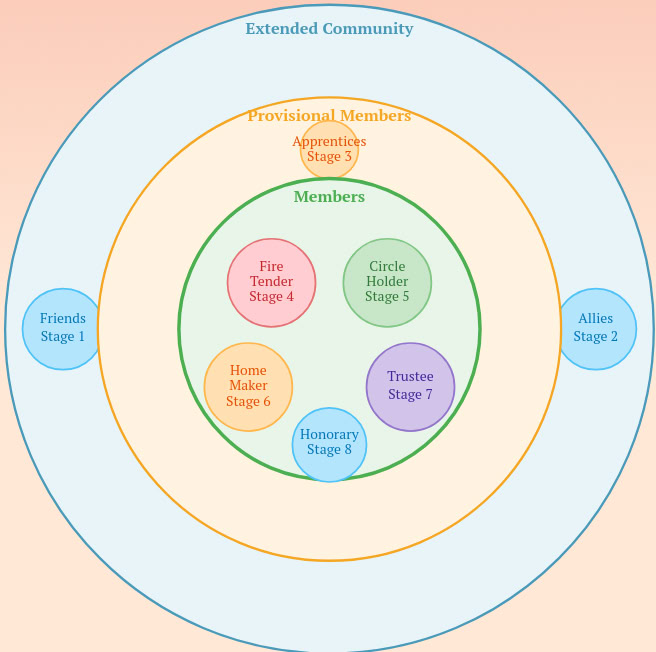
The two forks differ on one fundamental question: is Stage 3 the entry into the Association, or is Stage 4?
FORK A — Membership Begins at Stage 3 (Apprentice)
Logic: Stage 3 is when someone formally signs the Covenant, endorses the Constitution, and enters a trial period within the Association. They are a Provisional Member of the legal entity. Stage 4 is when that trial converts to full Active Membership.
| Stage |
Name |
Legal Status |
Governance |
| 1 |
Seed Planter |
Not a Member |
No vote, no voice in governance |
| 2 |
Rooted Ally |
Not a Member |
Advisory voice by invitation only |
| 3 |
Apprentice |
Provisional Member ← ENTRY |
Voice in Circles; observer in Assembly (no vote) |
| 4 |
Fire Tender |
Active Member (full) |
Full vote in Assembly + Circles |
| 5 |
Circle Holder |
Active Member |
Full vote + facilitation authority |
| 6 |
Home Maker |
Active Member |
Full vote + stewardship agreements |
| 7 |
Trustee / Guardian |
Trustee Member |
Board authority + fiduciary duty |
| 8 |
Wisdom Keeper |
Honorary Member |
Voice, no vote. No required duties |
What “real” membership means in Fork A:
-
Provisional Member (Stage 3): You are inside the Association, but in a learning/trial period. You’ve signed the Covenant and endorsed the Constitution. You have voice but no vote in Assembly. The community is watching; you are discerning.
-
Active Member (Stage 4+): Trial complete. Full vote. Full governance participation.
Strength of Fork A: The naming (Apprentice, Fire Tender, Circle Holder, Home Maker) is intuitive for everyday community use. The metaphors are grounded and accessible. Stage 3 as “Provisional Member” matches the Bylaws draft already circulating.
Tension in Fork A: The name Fire Tender at Stage 4 collides with the Executive Overview’s use of Fire Tender at Stage 3. Two documents, same name, different stages. If the Stewardship framework becomes the primary language internally, this creates ongoing confusion.
FORK B — Membership Begins at Stage 4 (Guide)
Logic: Stages 1–3 are entirely pre-membership: extended community and apprenticeship. Only at Stage 4 does someone formally enter the Association as an Active Member. Stage 3 remains a meaningful apprenticeship period but is not yet legal membership — it is the threshold, not the crossing.
| Stage |
Name |
Legal Status |
Governance |
| 1 |
Explorer — The Way Finder |
Not a Member |
No vote, no voice in governance |
| 2 |
Seeker — The Seed Carrier |
Not a Member |
Advisory voice by invitation only |
| 3 |
Participant — The Fire Tender |
Not yet a Member (Apprentice/Trial) |
Voice in Circles only; observer in Assembly |
| 4 |
Guide — The Circle Holder |
Active Member ← ENTRY |
Full vote in Assembly + Circles |
| 5 |
Steward — The Web Weaver |
Active Member |
Full vote + infrastructure stewardship |
| 6 |
Bridge — The Torch Bearer |
Active Member |
Full vote + attestation authority |
| 7 |
Guardian — The Map Keeper |
Trustee Member |
Board authority + fiduciary duty |
| 8 |
Sage — The Heart Counsel |
Honorary Member |
Voice, no vote. No required duties |
What “real” membership means in Fork B:
-
Stage 3 (Fire Tender) is a pre-membership apprenticeship — a formalized trial period with community rights (voice in circles, Assembly observer) but not yet legal Association membership.
-
Active Member (Stage 4+): First formal entry into the Association. You have signed the Covenant, endorsed the Constitution. Full vote. Full governance participation.
Strength of Fork B: Perfect coherence with the Stewardship Executive Overview. No name collision. The developmental arc reads as one continuous story. Stage 3 as “still becoming” and Stage 4 as “now belonging” is philosophically clean — the community has witnessed your tending of the fire and now trusts you to hold a circle.
Tension in Fork B: Stage 3 participants are doing significant work for the community (attending meetings, contributing labor, joining circles) but are not yet Members. This requires careful communication so they feel genuinely valued, not merely on probation. Also, the Constitution currently references Active and Founding Members as the voting class — Fork B is fully compatible with this, but Stage 3 must be clearly defined as a recognized pre-member participant category, not a Member class.
STAGE-BY-STAGE DETAIL: BOTH FORKS
Requirements, Rights, and Responsibilities shown for each stage, with Fork A / Fork B names where they differ.
STAGE 1
Fork A: Seed Planter (Friend/Visitor)
Fork B: Explorer — The Way Finder
Both: Extended Community. Not a Member.
Requirements to Enter:
- Fill in Membership Intent Form (select Stage 1)
- Sign the Membership Covenant
Rights:
- Welcome at open events, gatherings, and volunteer workdays
- Access to public commons spaces during designated hours
- Participation in orientation sessions
- Receive public communications
- Optional: sign node agreements for temporary/seasonal stay
Required Responsibilities:
- Respect community agreements, land, and cultural practices
- Practice conscious communication and consent
- Follow safety protocols
Governance: No voting rights in any body.
STAGE 2
Fork A: Rooted Ally (Ally)
Fork B: Seeker — The Seed Carrier
Both: Extended Community. Not a Member.
Requirements to Enter:
- Fill in Membership Intent Form (select Stage 2)
- Sign the Membership Covenant
- Active in a parallel aligned project or organization
- Acknowledged by any Active Member (lightweight — not formal Board approval)
Rights:
- All Stage 1 rights
- Advisory voice in governance or project meetings by invitation, on topics of relevant expertise
- Opportunity for Memorandum of Understanding for deeper alliance
- Platform to share aligned work through DBC communications when relevant
Required Responsibilities:
- Maintain ethical alignment with DBC values in own work
- Practice open communication about collaboration possibilities
- Honor reciprocity in resource sharing
Governance: No voting rights. Advisory voice by invitation only.
STAGE 3 — THE FORK POINT
Fork A: Apprentice → Provisional Member (legal entry into Association)
Fork B: Participant — The Fire Tender → Pre-member Apprentice (not yet Association member)
Requirements to Enter (both forks):
- Fill in Membership Intent Form: mark Join/Reconfirm, indicate intent toward Stage 4
- Endorse DBC Vision and Values as defined in the Constitution
- Acknowledge the Eight Stages of Stewardship as framework for growth
- Recommendation by 2 Active Members
- Welcomed at General Assembly
Rights (both forks):
- All Stage 1–2 rights
- Voice in Circles/Working Groups
- Vote in Working Groups when vouched by Active Members based on merit/expertise
- Observer in General Assemblies — voice but no vote, does not count toward quorum
- Access to internal communication channels
- Participation in mentorship programs and governance training
- Eligibility for emergency fund support
Required Responsibilities (both forks):
- Regular participation for minimum 3 months (may be shortened by Board approval)
- Contribute in at least 2 forms of capital
- Attend 50% of General Assemblies as observer
- Join and actively participate in at least one Working Group or Circle
- Welcome and support Stages 1–2 community members
- Maintain updated contribution record
Key Legal Difference:
|
Fork A |
Fork B |
| Legal status at Stage 3 |
Provisional Member of the Association |
Pre-member apprentice (not yet in the Association) |
| Signs Constitution-level affiliation at |
Stage 3 |
Stage 4 |
| Stage 3 in the Constitution |
Would require creating a “Provisional Member” category |
Sits outside formal membership, recognized as apprentice |
Governance (both forks): Voice but no vote in Assembly. May vote in Working Groups when vouched. Does not count toward quorum.
STAGE 4 — SECOND FORK POINT
Fork A: Fire Tender → Active Member (full, upgrading from Provisional)
Fork B: Guide — The Circle Holder → Active Member (first entry into the Association)
Requirements to Enter (Fork A — upgrading from Stage 3):
- Complete 3-month minimum as Provisional Member (Stage 3)
- Recommendation from sponsoring Circle/Working Group
- Board of Directors approval
- Sign Membership Covenant (if not already signed at Stage 3)
- Endorse DBC Bylaws
- Welcomed at General Assembly
- Create commitment statement
Requirements to Enter (Fork B — first formal entry):
- Complete 3-month minimum apprenticeship (Stage 3)
- Recommendation from sponsoring Circle/Working Group
- Board of Directors approval
-
Sign the Membership Covenant ← first formal signing
-
Endorse DBC Vision, Values, and Bylaws ← first formal endorsement
- Welcomed at General Assembly
- Create commitment statement
Rights (both forks):
- Full voting rights in General Assembly (counts toward quorum)
- Voice and vote in all Working Groups/Circles participated in
- Lead or co-lead projects, initiatives, or circles
- Eligibility for Board of Directors (after 1+ year as Active Member)
- Vouch for Stage 3 participants in Working Groups
- Access to all member resources and development support
- Emergency fund access
Required Responsibilities (both forks):
- Participate in at least 1 General Meeting per month
- Participate in 4 DBC impact meetings per year
- Attend at least one General Assembly per year (in person or online)
- Lead or co-lead at least one project or stewardship area
- Mentor at least one Stage 3 participant
- Respond to annual membership review
- Contribute in at least 3 forms of capital
Governance: Full voice and vote in Assembly and Working Groups. Counts toward quorum.
STAGE 5
Fork A: Circle Holder — Active Member
Fork B: Steward — The Web Weaver — Active Member
Description (Fork A): Specializes in facilitation, communication, and group coherence. Guides sociocratic circles, facilitates Assemblies, supports decision-making health across the collective.
Description (Fork B): Has stopped participating in individual threads and begun integrating them into fabric. Tends infrastructure — the systems, rhythms, and material conditions that make belonging possible. When absent, the gaps become visible quickly.
Note: These descriptions reflect genuinely different emphases. Fork A’s Stage 5 is relational/facilitative; Fork B’s Stage 5 is structural/infrastructural. Both are valid — they reflect what the community most needs to name at this stage.
Requirements to Enter (both forks):
- Sustained Active Membership at Stage 4, typically 1+ year
- Demonstrated facilitation capacity (Fork A) or infrastructure/systems capacity (Fork B)
- Recognition by peers and Board
Rights (both forks):
- All previous stage rights
- Authority to facilitate Assemblies and major circles
- Commons Stewardship Agreements (if land-based residency)
- Voice in meta-governance processes
Required Responsibilities (both forks):
- All Stage 4 responsibilities
- Facilitate at least one regular circle or Assembly per quarter (Fork A emphasis)
- Maintain commons spaces or infrastructure per Stewardship Agreement (Fork B emphasis)
- Host at least one community event per year
- Contribute in at least 4 forms of capital
Governance: All Active Member rights. Additionally holds facilitation or stewardship domain authority.
STAGE 6
Fork A: Home Maker — Active Member
Fork B: Bridge — The Torch Bearer — Active Member
Description (Fork A): Lives on or near DBC lands long-term. Holds Commons Stewardship Agreements — formal care responsibilities for specific land areas, facilities, or shared infrastructure. Provides daily care, welcomes visitors, models regenerative living.
Description (Fork B): Has been present long enough that their word carries the weight of lived experience. Carries institutional memory — context behind old decisions, patterns that repeat, contributions that went unrecorded. Formally attests others’ readiness for stage transitions. Bridges DBC to the bioregional network.
Note: These are the most divergent descriptions in the two forks. Fork A’s Stage 6 is land-based and residential; Fork B’s Stage 6 is relational and memorial. A community choosing Fork A may want to consider whether the Torch Bearer function exists somewhere in their structure — and vice versa for Fork B.
Requirements to Enter:
- Sustained Active Membership at Stages 4–5, typically 2+ years
- Fork A: Application for Commons Stewardship Agreement through Land Stewardship Council
- Fork B: Recognized by peers and Board for institutional memory and facilitation depth
Rights (both forks):
- All previous stage rights
- Fork A: Formal Commons Stewardship Agreement (housing, land use, project space)
- Fork B: Authority to formally attest a person’s readiness for stage transition
- Represent DBC in external collaborations
- Priority access to relevant training
Required Responsibilities (both forks):
- All Stage 4–5 responsibilities
- Fork A: Daily land care per Stewardship Agreement; host gatherings; welcome visitors
- Fork B: Facilitate at least one major council or Assembly per quarter; train emerging facilitators
- Contribute in at least 4 forms of capital
Governance: All Active Member rights, plus Fork A: operational authority within stewardship domain / Fork B: attestation authority for stage transitions.
STAGE 7
Fork A: Trustee / Guardian
Fork B: Guardian — The Map Keeper
Both: Trustee Member. Board of Directors / Trust Council.
(Names are essentially aligned. No meaningful fork here.)
Requirements to Enter:
- Sustained service at Active Member stages, typically 3+ years
- Nomination by Board or members
- Election by General Assembly (or Board appointment per Constitution)
- Acceptance of fiduciary responsibilities
- Reaffirmation of Covenant, Vision/Values, and Bylaws at Board level
- Typically serves 3-year renewable term
Rights:
- All previous stage rights
- Membership on Board of Directors or Trust Council
- Authority to sign legal and financial documents
- Full access to all organizational information
- Voice in constitutional amendments
- Representative authority with government, partners, funders
Required Responsibilities:
- Serve on Board / Trust Council with full participation
- Attend all Board meetings
- Exercise fiduciary duty: legal, financial, ethical oversight
- Guide strategic planning; ensure constitutional compliance
- Sign legal documents as authorized
- Mentor emerging leaders toward future guardianship
- Contribute in at least 4 forms of capital
Governance: All Active Member rights, plus Board/Trust Council authority, fiduciary responsibility, signatory authority.
STAGE 8
Fork A: Wisdom Keeper
Fork B: Sage — The Heart Counsel
Both: Honorary Member. Long-serving members who have walked the full journey through Stages 1–7.
Per Gap 4 decision: Honorary Membership is always and only for long-serving members who have completed the developmental journey. External collaborators recognized for exceptional contribution receive a separate form of recognition outside the Eight Stages framework.
Requirements to Enter:
- Many years of Active and Trustee Membership (typically 5–10+ years across Stages 4–7)
- Community recognition through General Assembly acknowledgment and celebration
- Elder accepting recognition and declaring chosen engagement level
- Ceremonial transition honoring service, contributions, and wisdom
Rights:
- Voice but no vote in General Assemblies (does not count toward quorum)
- Honored guest status at all events, gatherings, and ceremonies
- Lifetime connection to community regardless of residence
- Elder seat recognition at councils and assemblies
- Invitation to advise in Working Groups and Circles (no voting authority)
- Access to all community communications
Required Responsibilities (significantly reduced — by choice):
- Not subject to Active Member duties
- Maintain ethical alignment with DBC values
- Available for wisdom-sharing when called upon (with right to decline)
- Participate in annual Elder/Wisdom Keeper gathering if able
- Offer blessing or guidance for major decisions when requested
Governance: Voice but no vote in Assembly. Cannot be elected to Board or Fiscal Council. Does not count toward quorum.
SUPPLEMENTARY BYLAWS LANGUAGE
(Adopted for both forks equally)
Developmental Framework
The Eight Stages of Stewardship are the developmental layer of DBC’s governance architecture: the legal Association holds formal membership; sociocratic governance provides the decision-making methodology; the Eight Stages provide the developmental pathway through which people grow into membership, governance, and eventually into elder counsel. The stages describe the quality of relationship between a person and the whole. When the developmental journey is centered, governance capacity, succession readiness, and contribution clarity arrive as natural outcomes.
Sociocratic Governance Layer
Formal decision-making uses sociocratic consent as described in the Sociocratic Governance section of these Bylaws. A person’s stage describes their right to participate; the sociocratic process describes how decisions are made in the bodies they participate in. Both layers are required; neither replaces the other.
Contribution Recognition
Contributions across all stages are recognized through the Eight Forms of Capital (Roland & Landua, 2013): social, material, financial, living, intellectual, experiential, cultural, and spiritual capital. Members may track contributions through Bloom Network or equivalent systems. Tracking is encouraged at Stages 1–3 and expected at Stages 4–7 as part of accountability to the collective.
Stage Transitions
Movement through stages is recognized by the community, not assigned by administration. Transitions are witnessed — by Active Member recommendation (Stages 3–4), a Board review (Stages 6–7), or an Assembly ceremony (Stage 8). No one self-declares advancement.
Fluidity and Sabbaticals
Members may move between stages as life circumstances change. Transitioning to an earlier stage is not failure. Members at any stage may request sabbatical through communication with their Circle and the Board.
DECISION SUMMARY
| Decision |
Gap |
Fork A |
Fork B |
Status |
| Stage 1–2 names |
1 |
Seed Planter / Rooted Ally |
Explorer / Seeker |
Adopt Executive Overview names (Gap 1 resolved) |
| Where does “real” membership begin? |
2 |
Stage 3 — Provisional Member |
Stage 4 — First Active Member |
 NEEDS ASSEMBLY DECISION NEEDS ASSEMBLY DECISION |
| Stage 3–6 names |
2–3 |
Apprentice / Fire Tender / Circle Holder / Home Maker |
Fire Tender / Guide / Steward / Bridge |
Follows from membership entry decision |
| Stage 6 Bridge role |
3 |
Absent (absorbed into Home Maker) |
Present as Torch Bearer |
Consider even in Fork A |
| Stage 8 Honorary Member |
4 |
Always long-serving members who completed the journey |
Same |
 Resolved Resolved |
| Stage 2 Board recommendation |
5 |
Lightweight acknowledgment, not formal approval |
Same |
Resolved |
| Eight Forms of Capital in Bylaws |
6 |
Add Definitions section |
Same |
Add language |
| Developmental vs. governance layer |
7 |
Add framing paragraph |
Same |
Add language |
Document Status: Working Draft for Assembly Decision on Fork A vs. Fork B
Sources: APDC Bylaws Proposal (2025), Eight Stages of Stewardship Executive Overview (locked April 12, 2026), Constitución Asociación Puente Diamante Colectiva

 Proposal: Minimum Viable Membership Requirements and Benefits